





Improving Indoor Air for Babies: Do Air Purifiers Help With Mold Control?
There are a lot of parents who are concerned with the room and safety of their baby, and these concerns relate to allergens, moisture, or mold. Knowledge on how air purifiers help with mold is significant in that the mold cells could spread very easily in the air, and could cause irritation in the sensitive airways of your baby. Although air purifiers are the remedy to moisture problems, they can be used to trap the mould airborne particles before they can settle on the floor, or they can move around the room in the air.
To counter this, most families are implementing precautionary measures of having air purification systems in their nurseries and their homes. An ideally selected air purifier is specifically created to address such microscopic risks, yet one must comprehend its functions, as an air maintenance tool, not as a moisture solution, in order to control molds effectively. This guide will let you know about the function of air purifiers, how they help in mold control, and even in selecting the right air purifiers for your home. With the knowledge of the basics and the exposure to the best safety practices, you may develop a healthy nursery space with less doubt and fewer concerns.
Do Air Purifiers Help with Mold in Baby Rooms?
Air purifiers have the potential of being very effective in the elimination of airborne mold spores and particularly when they have a True HEPA filter. These filters trap small particles suspended in the air, so your baby won’t be able to inhale them. It is important to know that purifiers cannot eliminate the molds that grow on the surface. They are not exactly the solution for eliminating the molds, they are just a support tool.
That’s why it is necessary to combine a purifier and good ventilation, frequent cleaning, and moisture management. An excellent air purifier for infants can be used to enhance the general state of the air in the room of your baby, but only when this is combined with good home care.
How Do Air Purifiers Help with Mold and Indoor Air Safety for Babies?
A purifier filters these irritants, providing a softer environment where children breathe air. Though it does not cure allergies, it prevents the increase in triggers, disabling the symptoms. The filtration technology will determine how effective an air purifier is in keeping out the molds and other indoor hazards. To be safely used in relation to the infants, the filter system should be appropriate.
- HEPA Mining: The Mold Catcher
The real HEPA filter is made to capture 99.97 percent of particles of at least 0.3 microns in diameter. In most cases, the mold spores are huge, and thus, they are easily carried by the HEPA fibers. The HEPA filter is used for eliminating common breathing irritants and allergens in the house by continuously circulating the air in the house and extracting such biological particles.
- Activated Carbon: Addressing MVOCs
Mold releases gases known as MVOCs that give the damp places their musty smell and cause irritation to the lungs. These gases are captured via activated carbon filters, which bind the gases to the carbon surface. To be able to clean the air entirely, and in particular in a house with infants, it is necessary to use an air cleaner that integrates a HEPA filter and an activated carbon filter.
Do Air Purifiers Help with Mold Prevention in Nursery Areas?
Air cleaners are supportive in prevention. They prevent the spread of spores in carpets, curtains, and beddings that otherwise become traps for the molds. This lowers the risk of the spores falling in wet areas and multiplying their population.
Nonetheless, moisture control is needed in prevention as well. Mold grows well in damp locations, hence a purifier must be applied with:
- Dehumidifier in case the humidity remains high
- Proper ventilation
- Washing windowsills, walls, and cribs regularly
- Immediate drying of spills
Using a purifier together with these habits can be used to ensure that there is a lighter and more mold-resistant room for your baby.
Choosing an Air Purifier That Helps with Mold in Homes with Babies
When buying a purifier, paying attention to such functions that are designed specifically to combat mold spores and ensure the quality of air used in nurseries is worthwhile. Here are the main aspects to be taken into consideration:
- True HEPA Filter
This is the most necessary feature. Real HEPA filters can trap the tiny particles efficiently and are not dangerous to use in the surroundings of your baby.
- Activated Carbon Layer
Efficient in the elimination of odors, t\smoke, as well as the VOCs that are rather common in places prone to molds.
- Quiet Operation
The noise of nursery purifiers must be low during naps and at night.
- Suitable Room Coverage
Ensure that the purifier can serve the size of your nursery in order to achieve maximum resourcefulness.
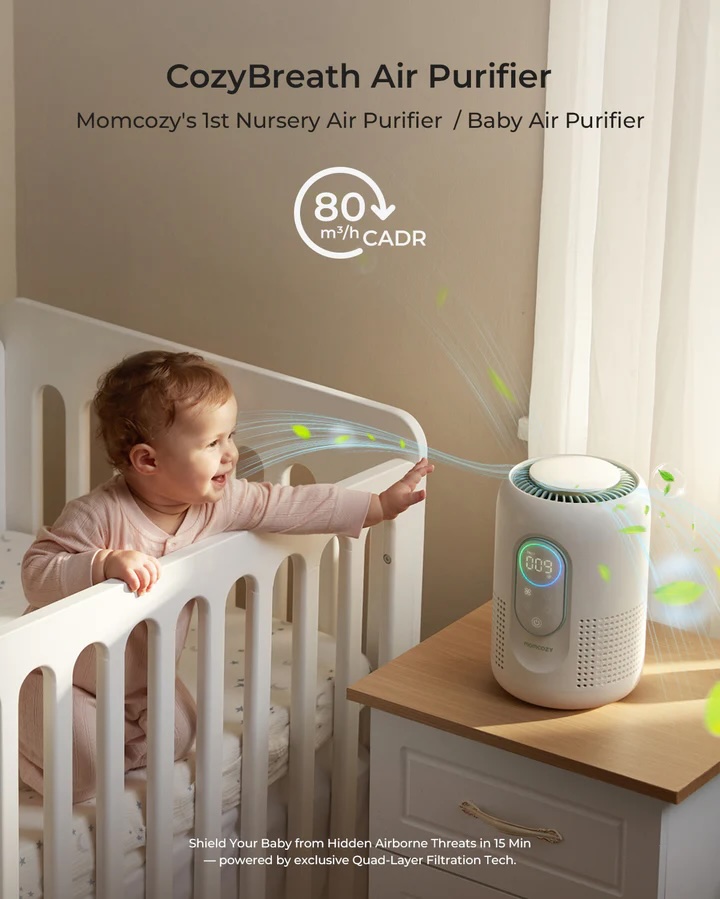
The right purifier maintains the quality of air in everyday life without disturbing the routine or posing any safety risks. Under these standards, the Momcozy CozyBreath Baby Air Purifier is highly recommended. You might want to check out this product; it meets all the criteria, is designed specifically for babies, and offers greater safety and peace of mind.
Do Air Purifiers Help with Mold Compared to Other Household Solutions?
Air purifiers can help defend against airborne mold spores quite effectively, but in combination with other measures to control molds. Here’s how purifiers compare:
| Solutions | Function | Limitation |
| Air Purifier | Work on eliminating spores in the air. Enhances good air quality. | Fails to eliminate the active growth of molds. |
| Dehumidifier | Lowers moisture content the prevent molds. Essential for damp climates. | Not able to filter the air Cannot remove the existing spores. |
| Cleaning & Ventilation | Removes visible mold | Requires regular effort |
| HVAC Filters | Able to catch particles Supports the whole house flow. | Not as effective as the HEPA purifier. |
All these methods combined will make a whole home mold-management plan. The air that you inhale is best treated by a purifier, whereas moisture and cleaning control prevent the mold at the process itself.
Conclusion
Dealing with mold in the room of a baby should be done in a balanced manner, and this is where the air purifiers come in to make it a cleaner and safer place to be. They are capable of reducing the spores that scatter around your house, but they cannot destroy the pre-existing molds, which can impact the breathing of your baby. A combination of a good purifier and good ventilation with proper cleaning and moisture control will help create a healthier environment in which your child can easily afford to sleep. Maintaining an environment free of molds in the nursery is easy for any parent with the use of the right tools and the right practice.
Header Photo Credit: Yan Krukau https://www.pexels.com/photo/face-of-woman-with-eyes-closed-5479750/

Related Posts
Timeless Style Meets Modern Comfort: Titanium Earrings for Every Lifestyle →

How the Right Dining Chairs Can Help You with the Perfect Setting →

Sustainable Photography: Giving Old Equipment a New Life →











Fantastic read! This article does an excellent job of breaking down what smart homes are and how they’re transforming modern…